Formerly Platinum Outsourcing
Formerly Platinum Outsourcing
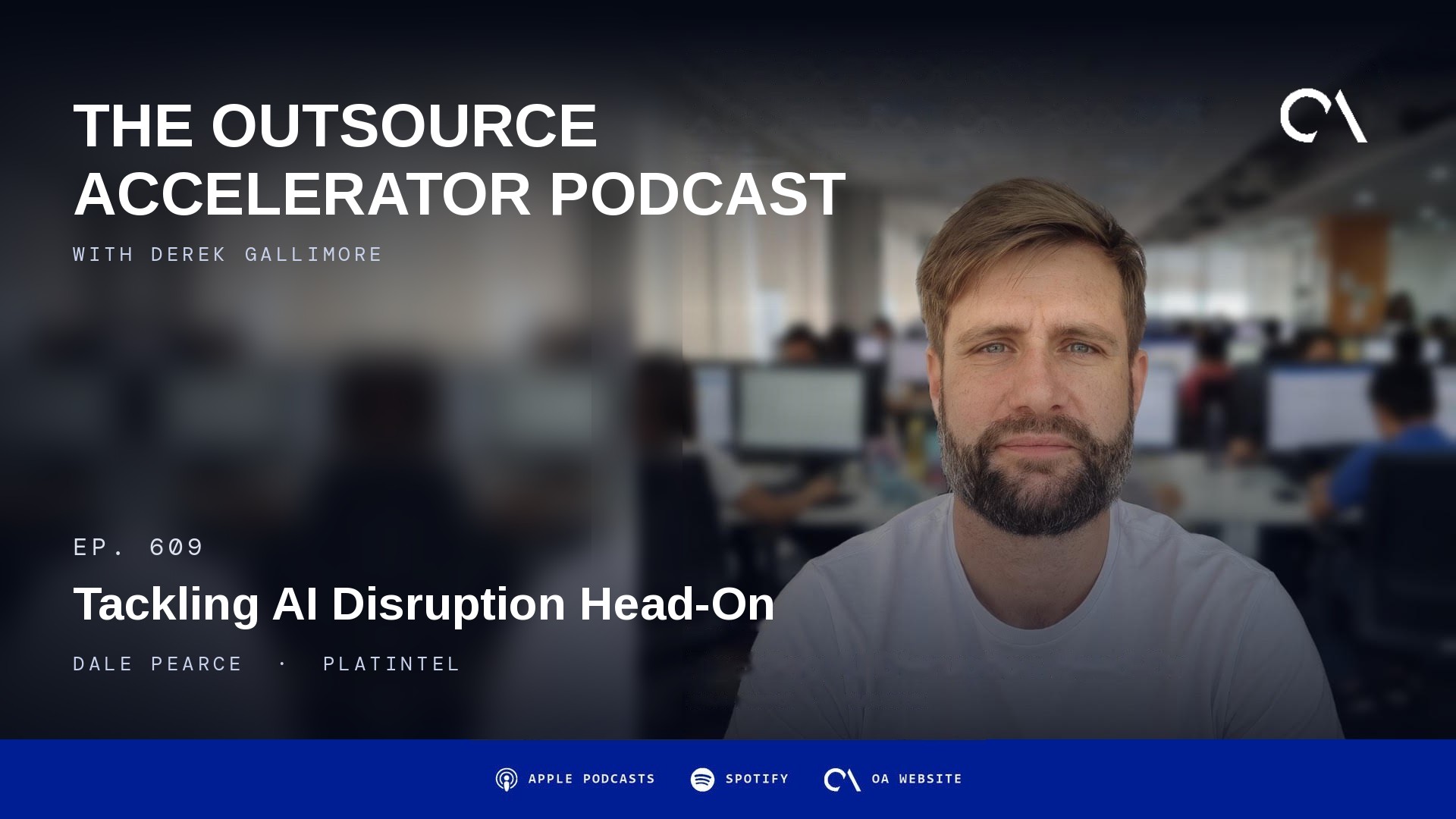
By Dale Pearce, COO, Platintel · Outsource Accelerator Podcast, episode 609 · Published by Outsource Accelerator on 12 November 2026 · 38 minutes
Episode summary
Dale Pearce is COO, Executive Director and one of two owners of Platintel (formerly Platinum Outsourcing), an Australian-owned offshoring and AI consulting company with delivery centres in Metro Manila, Jakarta and Pune. In Outsource Accelerator episode 609, he explains why change management, not technology, is the hard part of AI, and why most roles will become human-in-the-loop orchestrators.
This is Dale’s third time on the Outsource Accelerator Podcast with host Derek Gallimore, and his first since the rebrand. They talk about the rebrand, why businesses are cautious about hiring, where AI adoption really stands, and the AI consulting arm Platintel launches in January 2027.
Listen to episode 609 and read the show notes on Outsource Accelerator
Because the business is no longer just an outsourcing provider. Platintel now has two arms: offshoring, with teams in the Philippines, Indonesia and India, and a new AI consulting arm launching in January 2027. Dale says a quieter year also made it the right time to take on a job as big as a rebrand.
“Platinum Outsourcing served us well, but we're not just an outsourcing business anymore.”
Dale Pearce, COO, Platintel (10:55)
Dale sees a clear hesitancy to add headcount. High inflation and a tough Australian economy over the last 24 months, global uncertainty, and open questions about what AI means for their talent strategy have many businesses waiting. They want to see where the economy goes, and where automation could reduce the need for extra staff.
“Businesses have just kind of said, “Hey, we're just not going to hire at the moment.””
Dale Pearce, COO, Platintel (07:41)
Writing an AI policy and working out how to use AI is the easy bit. Getting people across a large organisation to change how they work every day is much harder, and Dale thinks that's why adoption is lagging. For smaller businesses, change management is a much smaller piece of the puzzle.
“The change management piece in organisations that are operating at scale is where the challenge is going to be.”
Dale Pearce, COO, Platintel (13:57)
It's the person who sits over an AI workflow, doing the prompting, setting the checkpoints and making sure what comes out is correct. Dale expects businesses to run a user interface on top of an agentic AI engine, with their people upskilled to manage it, rather than doing all the heavy lifting by hand.
“It's just essentially a person sitting there doing the prompting and setting up the checks and balances … making sure that whatever's being spat out is correct.”
Dale Pearce, COO, Platintel (21:37)
Dale's view is that most roles will change shape rather than disappear. Over the next two to three years, he expects the vast majority, from accountants and bookkeepers to customer support, creative, data analysis and software development, to become human-in-the-loop orchestrators. He still expects offshoring to grow, because businesses will keep looking for lower-cost economies.
“We'll always have a need for humans to be doing work in some capacity, and my belief is that businesses will still seek lower-cost economies.”
Dale Pearce, COO, Platintel (23:44)
It's a new arm, launching in January 2027, for businesses with 20 to 200 staff. Rather than building custom chatbots, the team helps businesses pick and set up off-the-shelf AI tools, put AI policies in place for good governance, and get a real return. It grew out of Platintel rolling out AI in its own support teams first.
“We're going to go out and say, “Hey, look, we've done this in our organisation. These are some tools that we think will save you X.””
Dale Pearce, COO, Platintel (16:02)
Platintel is looking at setting up an AI academy. It would start with a few roles, such as developers and accountants, and run intensives on a proper curriculum taught by an AI architect, ending in a qualification. The aim is for team members to start with a client already trained on the tools they'll use, at no extra cost.
“This wasn't about charging more money, because I think if we don't control the narrative in terms of AI use as an offshoring provider, our customers will control that for us.”
Dale Pearce, COO, Platintel (17:54)
Dale has been on the show twice before, when the business was still called Platinum Outsourcing. Platinum Outsourcing is now Platintel.
This transcript was made from the episode audio and lightly edited for reading: filler words removed, names and spellings corrected, and the sponsor read cut. Where the audio was unclear, it's marked [unclear]. Two company names in one answer have been replaced with a description in square brackets. Timestamps match the episode.
Derek Gallimore[00:00]
Hi, and welcome back to the show. Today I am joined by Dale Pearce. He is the Executive Director and Chief Operating Officer of Platintel. It has been a busy year for Dale. They have rebranded their business, formerly Platinum Outsourcing, and they are looking toward the future, which Dale strongly believes is firmly in the camp of AI. So whilst maintaining a very strong outsourcing business, they are leading with AI solutions for their business. It's becoming now a common theme for the industry, and it's really interesting to hear Dale's take and Dale's approach on this strategy. So it's a really good conversation with Dale. Dale has joined us two times before, so go back and listen to the old episodes. But it's a good conversation and I certainly learned a lot. As always, if you want any of the show notes, go to outsourceaccelerator.com/podcast. Enjoy.
Derek Gallimore[02:30]
Dale, welcome to the show. How are you doing?
Dale Pearce (COO, Platintel)[02:33]
Good, yourself, Derek? How are you?
Derek Gallimore[02:35]
Really good. Really good. Dale, it's great to have you back on the show. I think you've been on a couple of times before, and it's really good to hear updates from the real people on the ground working in the industry. Obviously there's a lot of changes. There's always changes in business, but it seems at the moment there's a lot more changes than usual, hopefully more positive than negative. But for those that haven't heard from you previously, maybe you want to introduce your newly rebranded company and yourself.
Dale Pearce (COO, Platintel)[03:10]
Yeah, thank you. Thanks, Derek, thanks for having me. I think it's the third time I've been on the podcast. So yeah, Dale Pearce, the Chief Operating Officer, one of two owners of Platintel, formerly Platinum Outsourcing. So we rebranded, I think it was between six and eight months ago. So essentially we help businesses build intelligent global teams. We have two arms of our business. We have the offshoring arm, and we have a newly minted AI consulting arm that officially launches in January of next year. But our core business essentially is as it has been since our inception, and that's helping businesses of all persuasions, across multiple geographies, build teams via our delivery centres. We have three offices. Predominantly the Philippines is where most of our team sits, in Metro Manila, but we also have an office in Jakarta, Indonesia, which is actually where we first started. And we now have a presence, very recently, in India, about three hours outside of Mumbai.
Derek Gallimore[04:21]
Gosh, well done. You've been busy. And what is the whole process behind three different geographies for your delivery centres?
Dale Pearce (COO, Platintel)[04:31]
Good question. I think each of those geographies have quite distinct talent pools. I think you could go to any of the three and you could probably get a VA from each of those locations, or potentially get an accountant to work in an Australian business from each of those locations. But I think they each have distinct strengths. So we wanted to give our client base access to a deeper and broader range of talent. And I guess we could speak about the Philippines and speak about Indonesia, but India for us, being the most recent one, the focus on trying to get a presence there was that we've recently entered the US market, so we're trying to sell into the US. What we see in the market, and what we believe is happening, is there's quite a large talent vacuum, a big gap between what businesses need in the US and what's actually available in the talent market around technical talent, software development, or moving into more technical roles across AI. And India tends to be, in our opinion, and has been for quite some time, I guess the leader globally in terms of technical talent. So that was the reason that we decided to land there recently.
Derek Gallimore[05:52]
That makes sense, that makes sense. And so, updates, Dale. You hinted a little bit before the show that it's been a busy year, and it has in many ways, and not least is, of course, the rise of AI. And whether it's the rise of AI or not, it's more the narrative around the rise of AI, isn't it? The expectation that it's going to change everything. I don't think that it's really changed things yet, but it's that expectation. But without focusing too much on just the AI, what's going on in the market? What are you seeing?
Dale Pearce (COO, Platintel)[06:30]
Yeah, it's been a bit of a funny year. I think at the start of the year, I can't remember the month, we obviously had the Middle East, there's issues that have inflamed there, and I think that's added a degree of uncertainty. And obviously the situation in Australia has been not ideal for businesses, not just this year but over the course of the last 24 months. High inflation, quite a tough economy, I think, to do business in at the moment. And then on top of that, there is uncertainty around what businesses need to do as it relates to enabling AI, and how that's going to affect their talent strategy going forward. So what we've found is there's definitely a hesitancy in adding to existing headcount, whether that's an existing team you're wanting to grow, or whether they don't have an offshore team and you're just going out and speaking with businesses that only have an onshore team.
Dale Pearce (COO, Platintel)[07:41]
So yeah, I think when we speak to people and have these discussions, they say, “Well, when the economy is bad, isn't that a good thing for you?” You know, obviously you can access cheaper talent markets in those countries we spoke about earlier. And yes, that is correct. But I feel at the moment businesses have just kind of said, “Hey, we're just not going to hire at the moment.” Or not hire to the degree we would have in previous years, to work out where the economy's going to go, number one, but also to where we can find efficiencies in terms of automation to potentially reduce the need for additional headcount. So that's kind of what I've seen in the market.
Dale Pearce (COO, Platintel)[08:26]
I think also, for us, and we actually spoke about it previously on the podcast, around the rebranding: any time you do a rebrand, you lose that equity. And I think there's some inertia that we'd built up over many years. Platinum certainly wasn't famous, but I think we had some good equity built into that, and when you change your brand I think you do lose a little momentum. So probably the culmination of a few things, but certainly I think the impact on our business of what's going on in the broader economy is probably the greatest driver of where we're at today.
Derek Gallimore[09:04]
I think people under-appreciate just that familiarity that you can lose. And also there's obviously the link juice from the original domain and things like that. I had the misfortune of having to rebrand one of my previous businesses, and it's a big job. It's a big, big job. And you look back and you go, did we win from that? It's really tough. Did you find it was a lot bigger job than you expected? Just changing all of your emails, changing all the documentation, all of the emails, all your domains, all the link juice, and then of course, as you say, that familiarity with the branding, with the name.
Dale Pearce (COO, Platintel)[09:53]
Yeah, so the rebrand, obviously it was a necessary evil. As you say, you do lose some of that momentum. But I think if there was a time we could pick to do it, it probably would have been this year. Things, as I mentioned a few moments ago, are relatively quiet. It's given us an opportunity to take pause and really focus on a few other aspects of the business that maybe had fallen by the wayside, or were getting neglected, just because we were so busy and we had such a huge amount of momentum. So yeah, I mean, we're happy with where we sit today, and we think the Platintel brand is going to be one that carries us into the future.
Derek Gallimore[10:31]
That's good. And congratulations. Businesses take a lot of work, and often there's so much work that goes on under the covers, under the waterline, that people don't really see and acknowledge. And it's essential though, isn't it? You want to build good infrastructure and build something that lasts. It's good to make those investments. They should pay off in the long term.
Dale Pearce (COO, Platintel)[10:55]
Yeah, absolutely. And I think it needs to represent where your business is in its current form. And for us, Platinum Outsourcing served us well, but we're not just an outsourcing business anymore. We do have the consulting arm, and we wanted to move away from just being known as a pure outsourcing provider, and really represent who we are and what we can offer going into 2027 and beyond.
Derek Gallimore[11:25]
That's exciting. So, other than the general economy, you're obviously seeing a big narrative around AI, and you're restructuring your business, or certainly the products of the business. More broadly, before we talk about your business, what are you seeing? Where is it heading with AI, do you think? Is it threatening to our industry? Is it opportunities for our industry? What are your thoughts there?
Dale Pearce (COO, Platintel)[11:55]
Yeah. So I think the last time we spoke on the podcast, and maybe the time before, I think it was that for there to be huge changes in our industry, whether it's AI or whatever it is, there needs to obviously be adoption in the onshore environment first, right? Businesses that we work with, that we build teams for. The only way we're going to be impacted is if they're making changes within their businesses that obviously flow through to us. I think we're still kind of in somewhat of a holding pattern. I don't think the adoption has really got to a point yet that there is a huge amount of disruption. I think, and I'd have to go back and have a look at the figures, but I think it's only something like 13 or 14% of Australian employing businesses have actually formally embedded or operationalised AI into their corporate structure. I think the actual numbers of people using it are higher, but it's not actually been formalised or embedded yet. So I think we're still a way off actually seeing what the outcome is going to be.
Derek Gallimore[13:15]
And do you think everyone's going to pick it up? I really have reservations about the adoption, you know what I mean? As an employer, you understand you can bang the drum trying to get your employees to do something, and it can take months just for them to pick up a new habit. And learning to code, or using Claude Code, and completely changing the way that you do things is a major step, isn't it? We both have smaller, more nimble companies, but if you're a massive company, how do you get all of the thousands of employees picking up Claude Code and suddenly coding their way to solutions, as opposed to just doing their job? Do you think that adoption is real?
Dale Pearce (COO, Platintel)[13:57]
Yeah, well, that's right. I think the biggest challenge, as you say, is you can go and build a policy, you can work out how to operationalise AI in your business, but the change management piece in organisations that are operating at scale is where the challenge is going to be. As you say, for businesses that are smaller, the adoption piece and the change management piece is a much smaller piece of the puzzle. But yeah, you're right. I think that is most likely why we're seeing the lag at a business level, because to actually get it to work and get it operationalised, it's quite a big piece. So yeah, 100%, I agree.
Derek Gallimore[14:49]
And what are you seeing then in terms of opportunities? Obviously you're steering your business towards this new business that you're venturing into. How do you see it? Is it AI implementation? Is it for one and all, or do you see it for specific verticals or industries? How do you see this playing out?
Dale Pearce (COO, Platintel)[15:18]
Yeah, so part of our rebrand was to look at what our strategy was moving forward as a business. So when we started that process, we really set out to do three things. The first one was to enable and operationalise AI in our own business. And that was not talking about billable staff, we're not talking about client teams, but looking at our support staff: finance, HR, customer success, IT, sales, talent acquisition. Looking at each of those areas of our business, and how we could enable and operationalise AI tools to make those roles more efficient. We started that process more than six months ago, and we're coming towards the tail end of that.
Dale Pearce (COO, Platintel)[16:02]
And then from there, the next part of that process was to work out how to then embed it into our offering, to act as a differentiator, at no to minimal cost to clients. And then the last part was to find a way to take what we learned through the process of doing those two things I just mentioned, to create new revenue streams. So there's really two things that came out of that, that have changed our operating model. Number one was we will open the consulting arm at the beginning of the new year, and that will focus on businesses that are between 20 headcount and 200 headcount. Very simply, without boring you with all the details, we'll be going out to those businesses and helping them operationalise and enable off-the-shelf AI solutions. We're not going to go out and try and tell them how they can build their own chatbots or anything like that. We're going to go out and say, “Hey, look, we've done this in our organisation. These are some tools that we think will save you X. We can show you how to use them, we can set up AI policies to make sure that you've got effective governance across what it's doing,” and help those businesses actually achieve ROI.
Dale Pearce (COO, Platintel)[17:28]
Part of the problem that we had when we started that process was there's just so many tools out there, and you're getting pulled in every which direction. You look at one tool, you might look at Claude and go, “Oh, this is fantastic,” and then the next day you've read some other article: “Claude's not the best, this is the best.” We just got pulled in every which way. It was quite stressful in the end, and we feel like, through that process, we can help businesses of a similar size get through that.
Dale Pearce (COO, Platintel)[17:54]
And then the last part was looking at ways we differentiate ourselves. And this wasn't about charging more money, because I think if we don't control the narrative in terms of AI use as an offshoring provider, our customers will control that for us, and I think there's more risk in the latter. So we're looking at setting up an AI academy, where we work initially with a few specific roles, whether that's developers or accountants, and they get put through intensives that are taught with a proper curriculum by an AI architect. And they come out with some form of qualification, so we can show these are the particular outcomes they achieved through the curriculum. When they start with the client, at no additional cost, that team member is essentially AI-enabled on the tools that they're going to be using in their business, and it will help those team members become more efficient from the first day, and hopefully save the client time in getting skilled on those tools.
Derek Gallimore[19:02]
That makes sense. Yeah, and I always think that's the holy grail for outsourcing, if you can actually be seen as a strategic partner to your clients, instead of a staffing vendor, instead of, you know, how we put bums on seats. It's really powerful, isn't it? Because ultimately the industry stems from business process outsourcing, which is ultimately optimising business processes. The outsourcing industry can add so much value into people's businesses and processes, but so often that is overlooked, and you're often just a vendor, put in the corner. If you can actually sit at the same table with them as a partner, as a strategic partner, an operations partner, an execution partner, then there's so much more value to be had by both parties. And it's really about winning that trust and authority from the clients, I suppose. And as you say, it can be life-changing to really build AI into existing operations. And I think, as you say, the adoption rates are still quite low. Many people don't have that attention or spare capacity to do that at the moment. So this is such a huge opportunity.
Dale Pearce (COO, Platintel)[20:29]
Absolutely. And yeah, it is an interesting one, trying to turn yourself from purely a supplier into a partner. I think that's the million-dollar question, and the offshoring companies that do well and grow and scale are the ones that are able to do that well, and do it over and over again. So that's where we're looking to get to, and what we're setting out to achieve.
Derek Gallimore[20:58]
And ironically, it still comes down to staffing, doesn't it? Because you need really good people at the controls running this AI. It's not going to happen by itself. AI is pretty powerful, but it's not going to go into a company by itself, turn itself on and figure stuff out. You still need the humans. So is this ultimately a Trojan horse to get humans into the business? And what are you looking for from a staffing perspective? What sort of roles would do this work? What people are you placing into organisations?
Dale Pearce (COO, Platintel)[21:37]
Yeah, again, I think that's a fantastic question. And probably how I'd answer that is, my personal opinion, from the exposure I've had to AI, is my feeling is the vast majority of roles will essentially become human-in-the-loop orchestrators. And what I mean by that is, I think the future, at least how I see it over the course of a few years, probably two to three years, is businesses will have a UI, or a user interface, and it will be built over some form of agentic engine, whether that's Anthropic or whatever that is. And then you'll have a human in the loop. And what I mean by that is, I don't need to explain it to you, but for those listening who might not know, it's just essentially a person sitting there doing the prompting and setting up the checks and balances, to make sure there's a few checkpoints through each workflow, making sure that whatever's being spat out is correct.
Dale Pearce (COO, Platintel)[22:43]
And I think a lot of roles will turn into essentially doing it that way: accountants, bookkeepers, customer support, creative, anything in data analysis, software development. I think a lot of the roles that are being done at the moment, where you just have someone sitting actually doing the heavy lifting, I think that will slowly dissipate, and you'll have those people be upskilled in whatever the tool is that the organisation is wanting them to use. And they will be the orchestrator that sits and essentially prompts and manages the checkpoints through each workflow.
Derek Gallimore[23:29]
Nice. And is it more consulting and advisory, or are you placing staff full-time, dedicated within an organisation? How do you see that playing out?
Dale Pearce (COO, Platintel)[23:44]
Yeah, so I think in terms of where we fit into that, I think the offshoring part of our business, and the outsourcing industry in general, will continue to grow. We'll always have a need for humans to be doing work in some capacity, and my belief is that businesses will still seek lower-cost economies to achieve margin retention, or whatever that is. So the industry is still growing, it's still healthy, and I think it will continue to be that way. And then I think those offshore providers, those of us in this space now, that survive will be the ones that are able to advise existing partners or potential partners on ways in which they can operationalise AI, working through [unclear] to make sure they're getting maximum efficiency from their headcount. That's where I see the industry going over the course of the next 24 months. And that's part of the reason, again, why we set up the AI side of the business.
Derek Gallimore[24:53]
Really exciting. And I suppose, maybe just remind the audience, what kind of outsourcing do you do? The reason I ask is call centres are really under threat. The roles that are high repetition, high volume, they're being replaced by AI, aren't they? Whereas I believe you're more into staff augmentation. They're critical roles, they're versatile roles within smaller organisations, and you can't so easily replace them. They're not so vulnerable to AI. Is that how you see things playing out? The big call centres are going to be up against it, but there's a lot of resilience in staff augmentation. Is that right?
Dale Pearce (COO, Platintel)[25:33]
Yeah, there is. It will be interesting to see the likes of [two of the largest global contact-centre providers], even those that have huge contracts and have a really large number of customer-facing staff. I think a lot of us in the industry, I know you included, Derek, it's been quite interesting to watch it play out, in terms of how they're going to transform those businesses and continue to be such a large influence on the industry, as they have been over the course of a number of decades. For us, we do have a contact centre component. We do still see some growth in customer support. As I mentioned earlier on, there's still those smaller contact centres in smaller businesses, might be 10, 15, 20 seats, and those businesses may not have even touched AI yet. They might be 12 to 24 months off, and they're still growing them. So yes, correct.
Dale Pearce (COO, Platintel)[26:35]
And as far as the other roles that we do, we do a lot in the IT and tech space, so full-stack development, quality assurance, DevOps. We're seeing a fairly sharp uptick in construction and engineering, so estimating, BIM coordinating, contract administration, that type of thing. And we do quite a bit in the creative space: motion graphics, graphic design, digital design. And then obviously we've got finance as well, and a number of other roles that people in the outsourcing industry would be familiar with, like executive assistants, live chat, HR, and all sorts of things. We're a full-service offshore provider. So yeah, it will be interesting to see where roles fall away over the next 12 months.
Derek Gallimore[27:25]
And do you see any tension between the two models? If one of your gurus comes in and optimises everything, and then they don't need the 10 staff they've got with you, do you see that as a potential point of risk?
Dale Pearce (COO, Platintel)[27:44]
Yeah, look, if we don't do it, someone else is. That's kind of the way we've looked at it. Businesses need to be across ways in which they can run more economically. The reality is, those client partners of ours who are not currently engaged with a consulting firm to look at how they can become more economical using AI, over the course of the next [unclear], they will have those discussions. They will go out to the market, they will find someone to talk to them, and I'd rather it be us having the discussion with them. So yeah, you're right, there will be some cannibalisation, but I think it's going to happen either way.
Derek Gallimore[28:30]
And what do you think? You mentioned at the top of the program that the economy has been tough and people have pulled back. There's an argument that outsourcing should be countercyclical, in that when times are tough, they come offshore because you save money, and you might let go of your onshore staff first and hire more offshore, because of course it's better on the wallet. But it doesn't often seem to be the case. It seems that people just contract when times get tough, and offshoring is a part of that. The same argument could be made with AI. If you're going to let people go, you let the expensive ones go first, the ones sitting in SF. I spoke to a friend slash client, and he's gone to a new business in California. They're paying their customer service staff 90,000 US a year base salary, and obviously there's huge on-costs on top of that. And apparently they don't even want to get on the phone. They refuse to get on the phone. They will only do email customer support. When times get tough, you'd want to let go of those ones first, not the ones in the Philippines on 20 grand a year. Long question, but do you think there's some countercyclical resilience in people offshore keeping their jobs instead of the ones onshore?
Dale Pearce (COO, Platintel)[30:06]
Yeah, you're right. It can go either way. Sometimes businesses will say, “Well, look, there's a downturn in the economy,” or “We've found efficiencies through XYZ, whether it's AI or something else,” and they will look to cut headcount through their offshore provider first. And then in other cases, they'll look to cut headcount based on what it says on their payroll ledger, in terms of who's being paid the most. And I guess that really comes down to the business. I don't think there's any rules or theory behind how it's going to happen. It just depends on the individual business. But yeah, we're seeing that as well. The cost of support, you know, that 90,000 figure in the States, but 70, 80 doesn't surprise me here in Australia now. And you've got on-costs with super, and the cost of having them in the office, or whatever else. It's a difficult time for businesses to make money, that's for sure.
Derek Gallimore[31:09]
And you've been in the business long enough now. I've been in the game 10-plus years trying to sell outsourcing to non-believers. Why on earth would you pay someone 90K in California when you'd get a better result offshore and save a ton of money? Do you still come across that resistance? Are you still finding businesses that are yet to take the outsourcing red pill? I'm still amazed.
Dale Pearce (COO, Platintel)[31:37]
Yeah, it does still amaze me sometimes. No, look, our outbound activity, in terms of our inside sales and what our SDRs do, is generally fairly well received. I think in most cases, when we pick up the phone and speak to someone, it's either “We already have a provider,” “We had a poor experience,” or “We're not ready to have the discussion.” So I think in most cases people are happy to at least engage and understand how it would work for their business. It's just a matter of getting them to commit to having that conversation. I think that's the same when you're selling anything. You've got to really push to get that initial conversation, get a decision-maker on the phone, and usually six or seven times out of ten that conversation ends up being a positive one.
Derek Gallimore[32:40]
Makes sense. Interesting times, exciting times for 2027. So you're entering a new market, the US, so there's a different client, a different market. And also you're offering a different product, a different service, which is more consulting, thought leadership, as opposed to bums on seats. How are you evolving your sales strategy? Is it the same, just a different market, different people? Or does the approach need to be particularly different?
Dale Pearce (COO, Platintel)[33:21]
Yeah, I think in terms of the offshoring business in the US, the strategy is different. The paid media landscape there is much more competitive than in Australia, so we're still working out the lay of the land there. So if any of my competitors are listening to this, [laughs] no. But yeah, the US obviously represents a much larger market, but that means there's obviously more competition. So we're trying to figure out what's going to work for us, and next year we think we're going to have a good strategy to get some growth in that market.
Dale Pearce (COO, Platintel)[33:57]
And then as far as the consulting, we're still in the very formative stages of completing and locking away our go-to-market strategy. That one will be heavily led by me, myself, going and actually just getting in front of businesses and saying, “Hey, this is what we've done. This is what we can do for you. Let me demonstrate the value.” And I actually think, to be perfectly honest, it will be an easier conversation than selling the offshoring at the moment. The trouble we had trying to find consultants, and the amount of snake oil salesmen that were trying to sell us things we didn't need, and some of the ridiculous quotes we got from people to try and build us things that made no sense for our business. I really think that there's some fatigue in the market, and businesses are crying out for someone to just come and be honest with them. And I think that's what we intend to do.
Derek Gallimore[34:52]
That makes sense. Well, exciting times ahead. So obviously you're going long on this thesis. The problem with AI is no one can really see over the horizon, and it seems like the horizon is moving every day. Where do you see this in 10 years? Well, let's say five years. Do we need any staff anymore at all? Or do you still need very strong staff steering this thing? What's your thesis for five years?
Dale Pearce (COO, Platintel)[35:32]
Yeah, I think it's anyone's guess. If you believe what is being written by some of the founders of the companies that are building this stuff, we might not be around in five years, which is a little bit [unclear]. Look, I'd like to think that in three to five years, as I mentioned earlier, we're all working alongside agentic tools in our day-to-day role, that it makes work more meaningful, more valuable, we have a more enjoyable time at work, and AI works in harmony with us. So that's where I'd like to see things go. But as you say, it's changing every minute, really. It's going to be an interesting few years, that's for sure.
Derek Gallimore[36:23]
Yeah, it's fascinating, isn't it? I think you've just got to drive forward. I vacillate between every single job is gone and no one's ever going to work again, to nothing's really going to change. It's so volatile, isn't it? So difficult to plan anything.
Dale Pearce (COO, Platintel)[36:45]
[Unclear.] So I think you're right. You just got to push forward and continue on, and we'll see where we end up in a few years.
Derek Gallimore[36:55]
Yeah. Well, that's really exciting. So congratulations on the rebrand and the new direction, and all of the success you've had to date. It's certainly exciting. Are you going to sell the AI integration work through the same brand, or are you setting up a separate brand?
Dale Pearce (COO, Platintel)[37:17]
It's all under Platintel. So it'll all be under the same brand. We'll run our offshore business and the consulting all under the same Platintel brand. I don't think I could go through trying to create another brand again after the rebrand. So we'll stay Platintel for a while.
Derek Gallimore[37:32]
I think that's brilliant. That's a good move. Well, Dale, congratulations. And as always, I encourage people to reach out and have that conversation. If anyone wants AI integration, certainly reach out for a conversation. How can they get in touch or learn more?
Dale Pearce (COO, Platintel)[37:49]
For sure. So, platintel.com. You can get online there and browse the website and learn all things about building global teams, and the AI consulting arm, which, as I mentioned, doesn't launch officially until January 2027. So there'll be some changes to the website in terms of how that will go to market in that space. And yeah, we can be contacted at info@platintel.com.
Derek Gallimore[38:13]
Dale, fantastic. Thanks so much.
Derek Gallimore[38:18]
That was Dale Pearce, the Executive Director and Chief Operating Officer of Platintel. As always, if you want any of the show notes, go to outsourceaccelerator.com/podcast, and if you want to ask us anything, drop us an email at Outsource Accelerator. See you next time.
If you’re weighing up an offshore team, or wondering where AI fits in your business, we’re happy to have an honest chat. Get in touch with the Platintel team.